Problem
As synthetic images become more common, distinguishing generated images from real ones is an important applied classification task with practical trust and quality implications.
Coursework Project
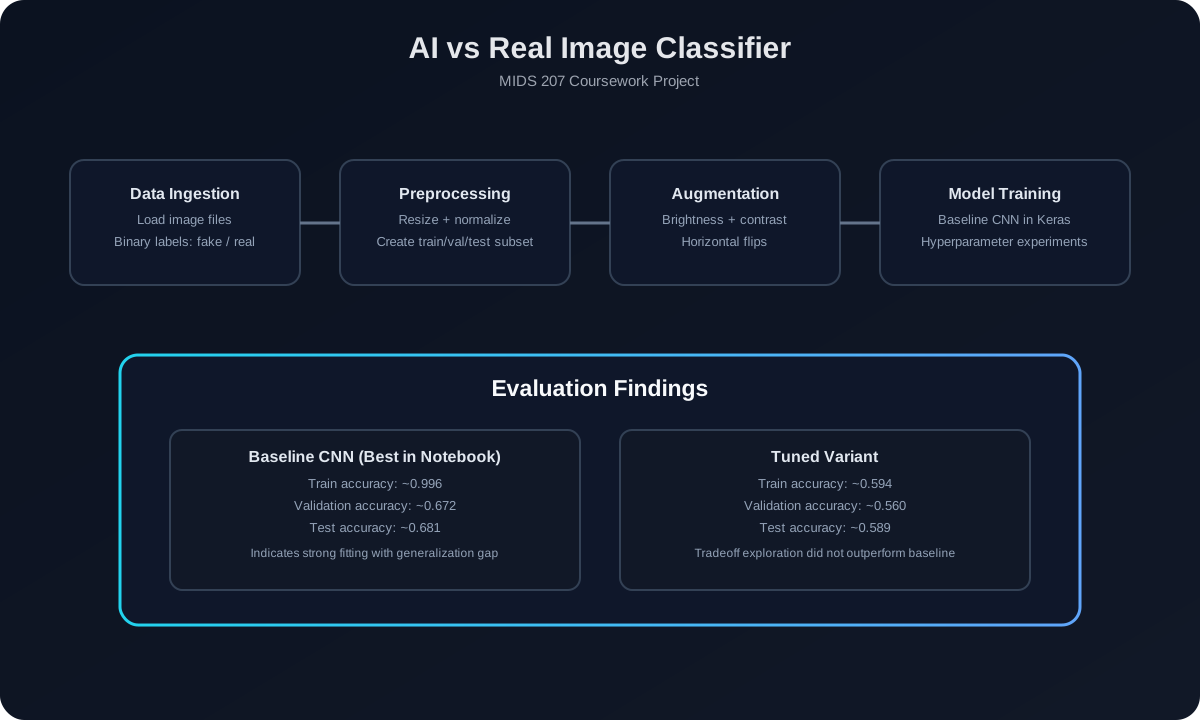
Computer vision project focused on classifying whether an image is AI-generated or real. The workflow covers preprocessing, augmentation, CNN baseline modeling, and hyperparameter experiments with TensorFlow/Keras.
Problem
As synthetic images become more common, distinguishing generated images from real ones is an important applied classification task with practical trust and quality implications.
Approach
Built a binary classifier pipeline using TensorFlow/Keras with train/validation/test splits, augmentation (brightness, contrast, flips), and iterative architecture tuning.
Outcome
Established a baseline CNN achieving around 68% test accuracy on the held-out subset and used additional experiments to understand generalization and overfitting tradeoffs.
In the recorded notebook outputs, the baseline CNN reached approximately 0.996training accuracy, 0.672 validation accuracy, and 0.681 test accuracy. This performance profile suggests the model learned strong class boundaries on training data while still leaving room to improve generalization.
A tuned variant did not outperform baseline on validation/test metrics, which reinforced the importance of careful architecture and regularization decisions for this dataset.